
Let me begin with something important. Wanting reassurance does not mean you are failing. Reassurance can feel like care. When worry is loud, hearing “You are okay,” “Nothing bad will happen,” or “You did not do anything wrong” may bring a wave of relief. We all need comfort and support.
The problem begins when reassurance becomes the main way we manage uncertainty. The relief may be real, but it often does not last. A new doubt appears, the question changes slightly, or the mind asks whether the person giving reassurance truly understood. Soon, the urge to ask again returns.
This pattern is common in anxiety and obsessive compulsive disorder, often called OCD. Research has found that reassurance seeking is more frequent among people with OCD and other anxiety disorders than among people without those concerns (Kobori & Salkovskis, 2013).
In my work, I help people notice this pattern without shame and practice a different response.
Why reassurance feels so powerful
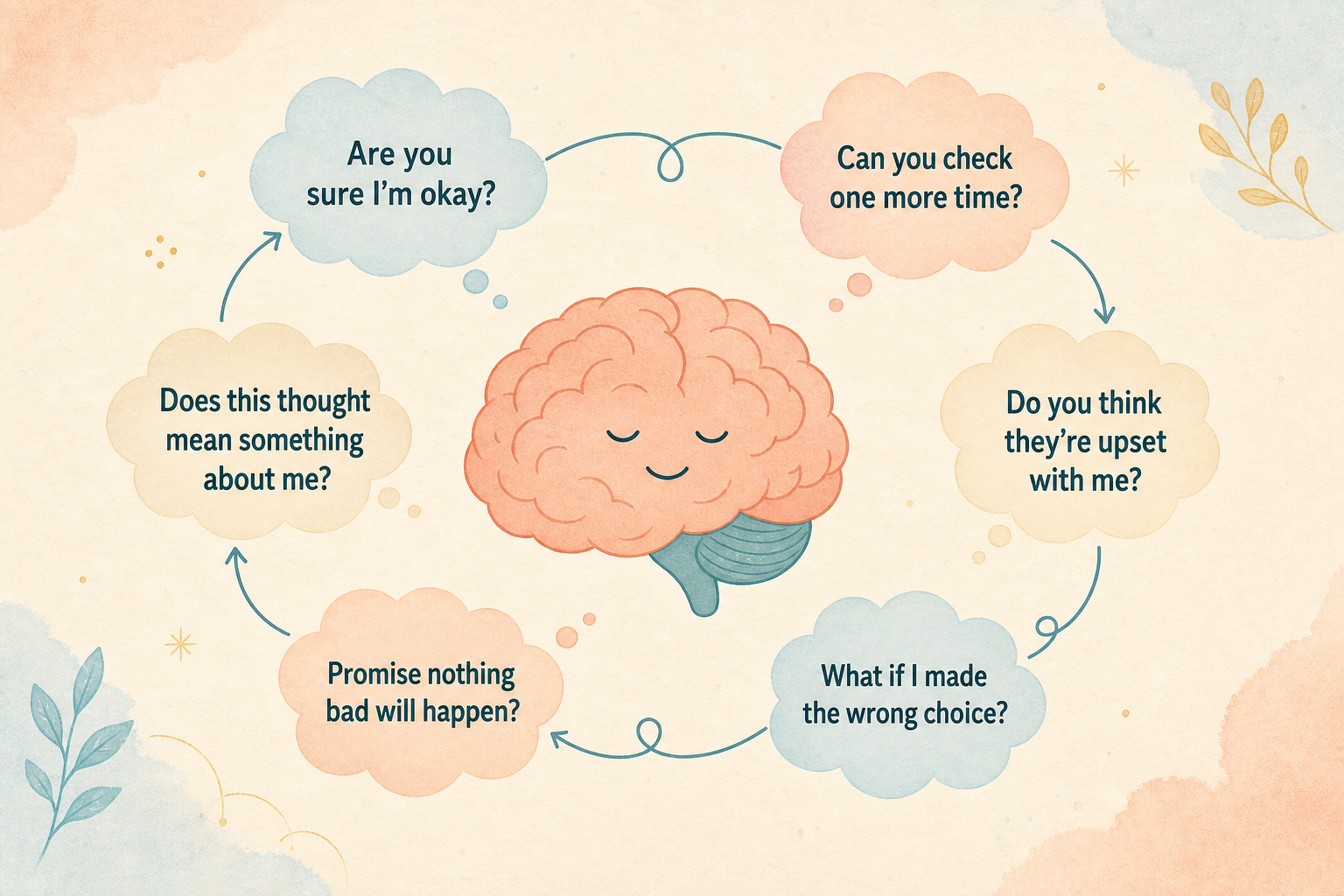
An anxious mind wants certainty. It may ask:
“What if I made the wrong decision?”
“Are you sure I am not sick?”
“Do you think they are angry with me?”
“What if that thought means something terrible about me?”
When someone answers, anxiety may drop. The brain notices that relief and learns a simple lesson: When uncertainty feels dangerous, ask for reassurance. That lesson makes sense in the moment. Over time, however, it can prevent the brain from learning something more helpful: uncertainty can be uncomfortable without being an emergency.
Studies connect reassurance seeking with obsessive compulsive symptoms, anxiety, beliefs about threat and responsibility, and a strong need for certainty (Hacıömeroğlu, 2020). Similar feedback seeking patterns can also appear in generalized anxiety and social anxiety (Wilson et al., 2018).
Trigger and doubt
1Anxiety and urgency
2Checking or reassurance
3Temporary relief
4Stronger future doubt
Reassurance can also be internal. You might repeat a comforting phrase, mentally review an event, compare symptoms, replay a conversation, or keep searching for the perfect answer.
Support is not the enemy
The goal is not to stop asking questions or become emotionally isolated. Helpful information seeking usually has a clear purpose and a reasonable stopping point. Reassurance seeking tends to repeat, demands certainty that no answer can fully provide, and offers relief that fades quickly.
You can ask yourself:
“Am I gathering new information, or am I trying to make anxiety disappear?”
“Have I already received a reasonable answer?”
“Will another answer help me act, or will it restart the search?”
These questions are not meant to shame you. They help you notice what the worry is asking you to do.
Six practical ways to loosen the cycle
Name the pattern gently
One of the first practices I often suggest is saying, “I notice that I want reassurance because I feel uncertain.” This separates the feeling from the action. You are not telling yourself that the concern is foolish. You are identifying an urge before automatically following it.
Pause before asking
You do not have to stop reassurance all at once. Begin with a short delay. Wait five minutes before asking, checking, or searching. During that pause, allow the discomfort to be present without trying to solve it.
As this becomes more manageable, gradually lengthen the pause. The goal is not to force anxiety away. The goal is to discover that an urge can rise and fall without controlling your behavior.
Practice a response to uncertainty
Anxiety asks for a guarantee. A more flexible response might be:
“I cannot know with complete certainty.”
“Maybe that is possible, and I can handle not solving it right now.”
“I have enough information to take the next reasonable step.”
This is not positive thinking. It is an honest acknowledgment that everyday life includes uncertainty. Be careful not to repeat these statements until they feel perfect, since even a helpful phrase can become another ritual.

Choose one reasonable source
If you truly need information, decide in advance where you will look and when you will stop. You might consult one qualified professional, read one reliable source, or ask one clear question.
For health and safety concerns, appropriate professional guidance matters. Reducing compulsive reassurance does not mean ignoring medical advice, immediate danger, abuse, or a genuine emergency. It means creating boundaries around repeated checking after adequate information has already been received.
Return to meaningful action
After noticing the urge, ask, “What would I be doing if I were not trying to become completely certain?”
You might return to work, take a walk, call a friend without discussing the worry, prepare dinner, pray, rest, or complete a task that reflects your values. Meaningful action teaches the brain that uncertainty can travel with you without running the day.
Slow breathing, grounding, and mindful attention can support this step. Use them to stay present, not as tests that must remove anxiety before you continue.
Consider cognitive behavioral therapy and ERP
Exposure and response prevention, commonly called ERP, is a form of cognitive behavioral therapy with strong evidence for OCD. With clinical guidance, a person gradually faces a feared thought or situation while reducing the ritual, avoidance, or reassurance that usually follows. The purpose is to build new learning and greater freedom, not to overwhelm someone or prove that their fear is ridiculous (Hezel & Simpson, 2019; Law & Boisseau, 2019).
ERP should be planned thoughtfully. A trained therapist can help identify subtle rituals, choose manageable practice steps, and adjust treatment for trauma history, culture, health needs, family relationships, and the person’s readiness.
How loved ones can help
Family members and partners often provide reassurance because they care. They may also feel trapped between wanting to comfort someone and realizing that no answer lasts. Treatment guidance recommends helping loved ones reduce their involvement in reassurance and compulsive behavior in a sensitive, supportive manner (National Institute for Health and Care Excellence, 2005).
A supportive response might sound like:
“I can see that this uncertainty is painful.”
“I love you, and I do not want to help the worry keep you stuck.”
“What response did you and your therapist decide to practice?”
“I can stay with you while the feeling passes, but I am not going to answer the same question again.”
The tone matters. Cold refusal can feel punishing. Warm consistency communicates both compassion and confidence.
How DuraCare Counseling can help
You do not have to untangle this cycle by yourself.
In my work at DuraCare Counseling, I offer a warm, collaborative space to understand how worry, reassurance, checking, avoidance, relationships, identity, and life experiences may be working together.
Counseling is tailored to you, not just the symptom. I draw from cognitive behavioral, holistic, solution focused, trauma informed, culturally responsive, and strengths based approaches. When appropriate, treatment can include carefully planned strategies for tolerating uncertainty, reducing reassurance, changing anxious habits, and reconnecting with the parts of life that matter most.
If worry keeps asking for one more answer, therapy can help you build confidence in something deeper than certainty: your ability to respond thoughtfully even when you do not know everything.
Ready to learn more? Contact Wendy Q. Durant to schedule a consultation and begin your journey today.
Email info@duracarecounseling.com or call (504) 708 5405.
This article is educational and is not a substitute for individualized mental health or medical care. In an emergency, contact local emergency services.
References
Hacıömeroğlu, B. (2020). The role of reassurance seeking in obsessive compulsive disorder: The associations between reassurance seeking, dysfunctional beliefs, negative emotions, and obsessive compulsive symptoms. BMC Psychiatry, 20, 356. https://doi.org/10.1186/s12888-020-02766-y
Hezel, D. M., & Simpson, H. B. (2019). Exposure and response prevention for obsessive-compulsive disorder: A review and new directions. Indian Journal of Psychiatry, 61(Suppl 1), S85–S92. https://doi.org/10.4103/psychiatry.IndianJPsychiatry_516_18
Kobori, O., & Salkovskis, P. M. (2013). Patterns of reassurance seeking and reassurance-related behaviours in OCD and anxiety disorders. Behavioural and Cognitive Psychotherapy, 41(1), 1–23. https://doi.org/10.1017/S1352465812000665
Law, C., & Boisseau, C. L. (2019). Exposure and response prevention in the treatment of obsessive-compulsive disorder: Current perspectives. Psychology Research and Behavior Management, 12, 1167–1174. https://doi.org/10.2147/PRBM.S211117
National Institute for Health and Care Excellence. (2005).Obsessive-compulsive disorder and body dysmorphic disorder: Treatment (Clinical guideline CG31). https://www.nice.org.uk/guidance/cg31
Wilson, G. A., Koerner, N., & Antony, M. M. (2018). An examination of feedback seeking in individuals with social anxiety disorder, generalized anxiety disorder, or no history of mental disorder using a daily diary method. Journal of Cognitive Psychotherapy, 32(1), 15–37. https://doi.org/10.1891/0889-8391.32.1.15

About the author
Wendy Q. Durant
Wendy is the founder of DuraCare Counseling and Consulting Services. She provides warm, collaborative, whole person care for adults, couples, teens, and families. Her work helps clients understand difficult patterns, strengthen practical coping skills, and create meaningful change with compassion and clarity.